

Frontier Intelligence Is Becoming Permissioned: The Kimi K3 Licensing Readout
Across Washington, Moonshot and Beijing, frontier intelligence is becoming permissioned. Kimi K3 shows how free weights can coexist with privileged serving rights and a commercial toll on distribution.
Frontier intelligence is becoming permissioned. Over 7 weeks:
→ Washington used sovereign access controls. A June 12 directive resulted in Anthropic’s Fable 5 and Mythos 5 being suspended globally; the shutdown ran 19 days. Mythos remains gated to a government-approved, company-vetted set of organisations. OpenAI launched GPT-5.6 to ~20 government-vetted partners; broad release took another 13 days.
→ Moonshot used channel licensing: Kimi K3’s weights are free to download, fine-tune, and self-host. But any Model-as-a-Service business whose group revenue exceeds $20M in any trailing 12 months must sign a commercial agreement before serving it; a toll on the serving layer.
→ Beijing is considering sovereign controls of its own: filings on weaker open models, security reviews for stronger ones, a possible publication ban on the strongest, and national-security penalties for leaking weights.
Who the licence exempts
These are who the licence exempts, in Kimi K3’s case. Alibaba, a ~36% shareholder and Moonshot’s compute provider, launched hosted K3 APIs the day the weights dropped, as did Tencent, another shareholder of Moonshot. The biggest US hyperscalers did not.
The open-weights patent bargain
This is the OpenAI–Azure playbook rebuilt for open weights: capital and compute in, privileged serving rights out. Moonshot rebuilt the patent bargain by contract: disclose the artifact, reserve the commercial window.
Why timing matters
Timing is important. Frontier attention arrives in release-cycle pulses that decay fast; K2.6 went from #2 to #20 on OpenRouter in eight weeks. The K3 weights dropped July 27. Certified partners serve from day zero. Everyone else negotiates for weeks, roughly the life of the pulse. The pulse had to be monetised by partners, as it was bigger than the racks of Moonshot, who had to pause new subscriptions within 48 hours of the launch.
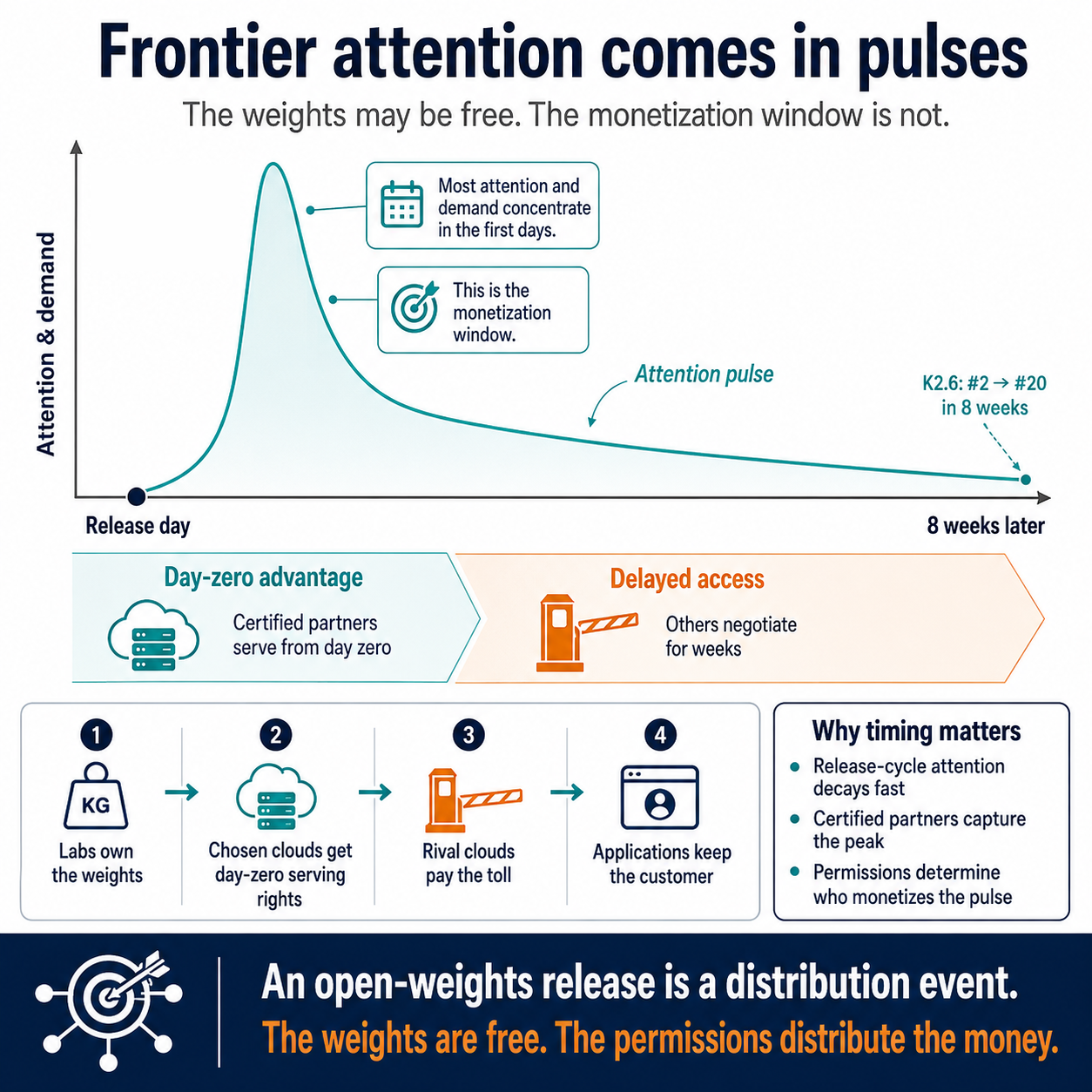
The emerging structure:
→ Labs own the weights.
→ Chosen clouds get day-zero serving rights.
→ Rival clouds pay the toll.
→ Applications keep the customer, exempt from the toll.
An open-weights release is a distribution event. The weights are free. The permissions distribute the money.
Disclosure
This article is for informational and analytical purposes only and does not constitute investment advice.
Principal sources
- Anthropic, statement on the US government directive concerning Fable 5 and Mythos 5 access, June 12, 2026.
- OpenAI, GPT-5.6 Preview System Card, June 26, 2026.
- Moonshot AI, Kimi K3 technical blog; and Kimi K3 model card, weights and licence.
- Alibaba Cloud Model Studio, model release and lifecycle listings.
- OpenRouter, public model-usage rankings.
- Reuters, reporting on possible Chinese controls on access to advanced AI models, July 2026.
- Reuters, reporting on Moonshot’s subscription pause and its computing arrangement with Alibaba, July 2026.